Most people ordering custom rope hats spend all their attention on two decisions, the rope color and how to decorate the front, and then leave the blank itself to chance. That is backwards. The blank’s construction, its profile, whether the front is stiffened, how many panels it has, what the back is made of and how it closes, determines how the hat sits on a head and whether your logo lands flat or fights a curved, collapsing surface. Get the blank right and everything else is easy. Get it wrong and no amount of nice embroidery rescues it.
This is a walkthrough of the specifications that actually define a rope hat, in the order you should decide them, so you can hand a supplier a spec instead of a vibe.
Start with profile: how tall the front sits
Profile is the height of the front crown, and it sets the whole silhouette. Low profile caps sit close to the head with a shorter front panel, roughly three to three and a half inches, and read as casual and modern. Mid profile, in the neighborhood of three and a half to four inches, is the safe middle ground and the height of the classic trucker-and-rope look most people picture; the widely used Richardson 112 is a mid-profile structured trucker, for reference. High profile fronts, around four and a quarter to four and three-quarter inches, stand tall and give the most vertical room for a large logo or a stacked design. The chart below shows those indicative height bands.
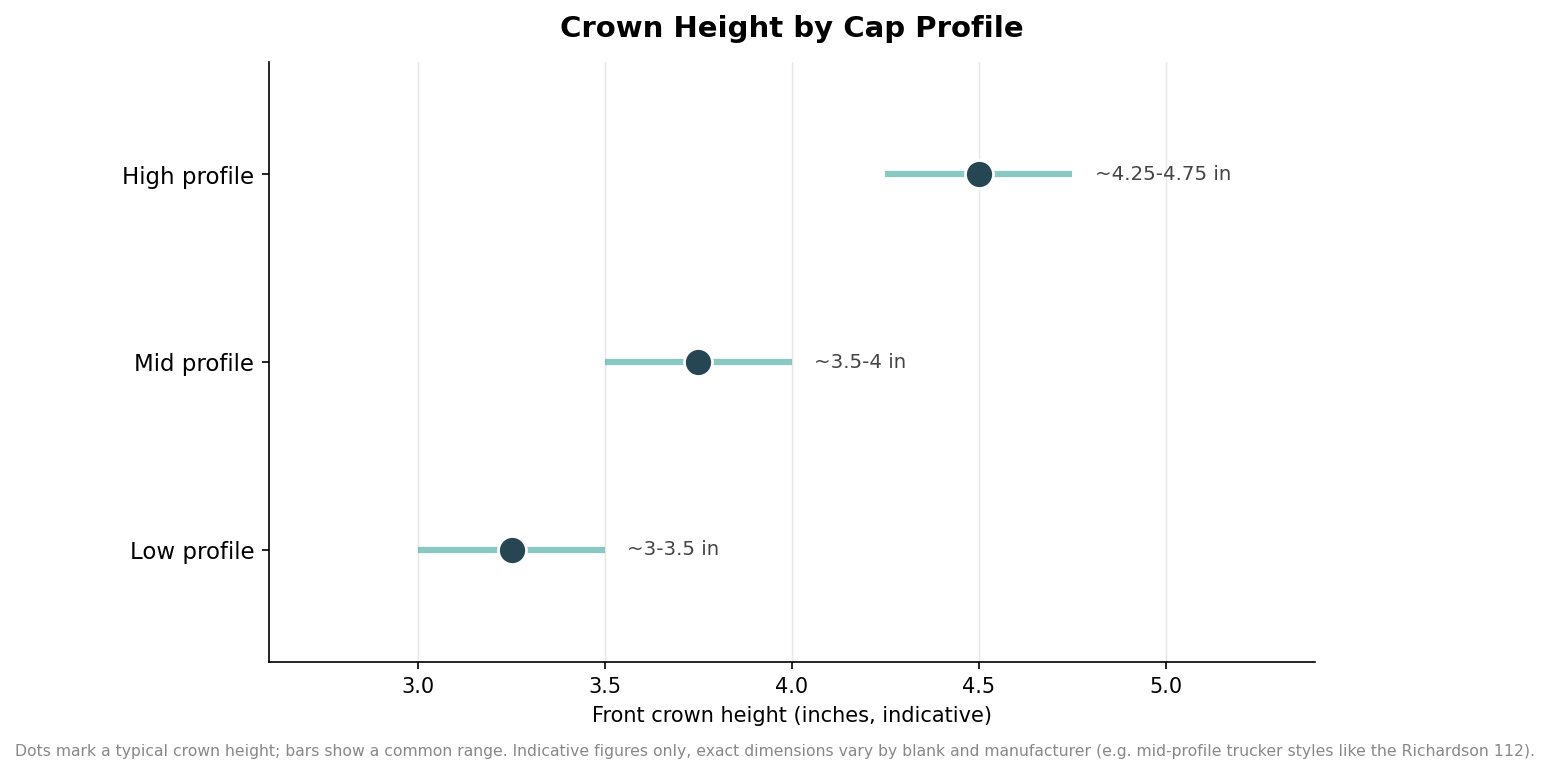
Profile matters beyond looks because it sets your usable decoration area. A tall embroidered crest or a big leather patch needs a mid or high profile to breathe; force it onto a low-profile front and it either shrinks or crowds the seam. Decide profile with your artwork in hand, not after.
Structured or unstructured: the single biggest fit decision
The next choice does more to change the hat than any other. A structured cap has a stiff, treated fabric called buckram sewn behind the front panels, which holds the crown upright even when the hat is off a head. That firmness is why structured fronts keep a logo flat, legible and unwrinkled, and it is the reason most foam-front rope and trucker styles are structured. An unstructured cap omits that backing, so the front is soft and conforms to the wearer’s head, giving a broken-in, low-key feel that packs down easily but lets the front fabric shift and bunch, which makes clean embroidery harder and can require extra stabilizer.
Neither is better in the abstract; they are good at different things. The comparison below lays out the trade-off directly.
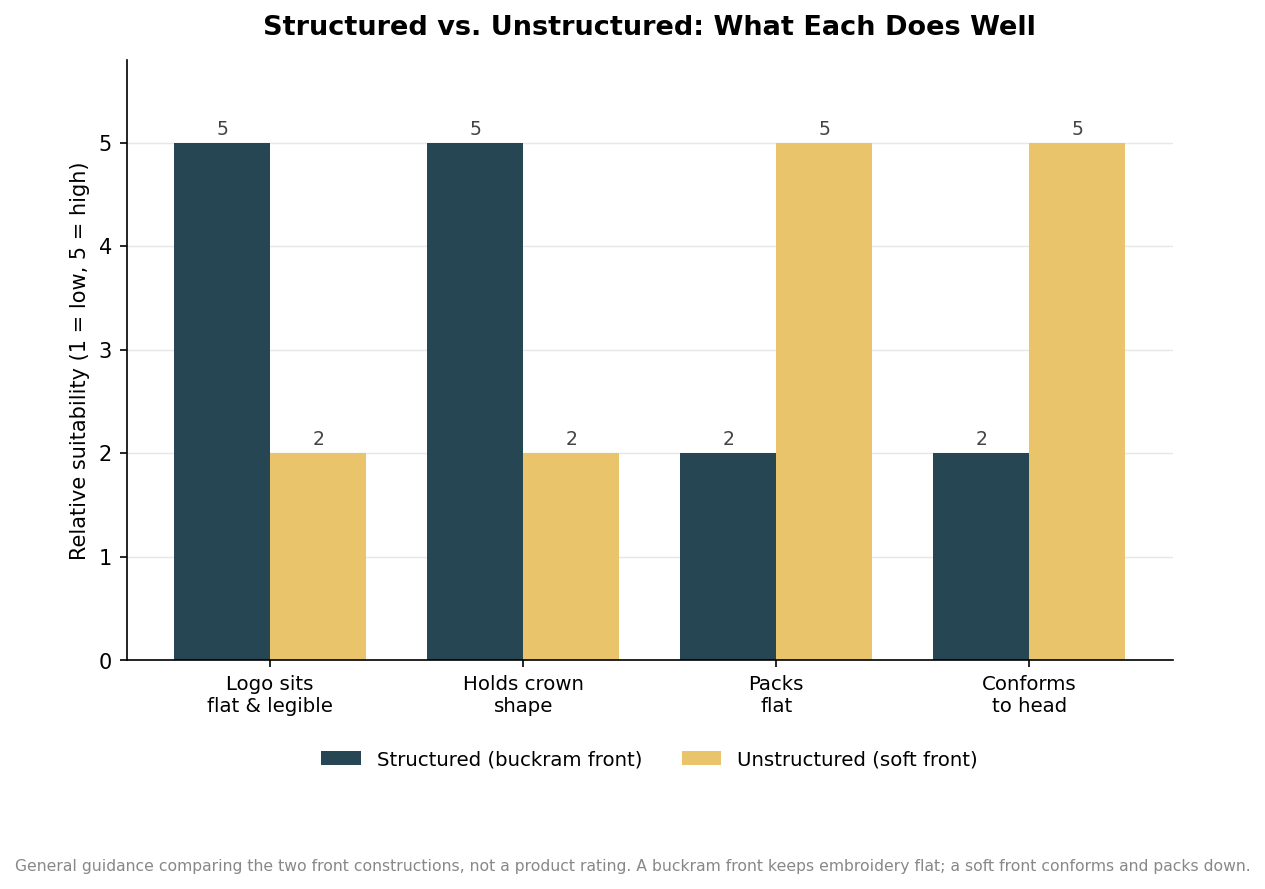
The practical rule: if a crisp, flat, always-legible front logo is the priority, especially a dense embroidered mark or a patch, choose structured. If you want a soft, casual, packable hat and your decoration is small or forgiving, unstructured is fine. For a promotional rope hat where the whole point is the branding on the front, structured is usually the right default.
Panels, back and brim
A few construction details round out the spec. Panel count affects the front seam: a five-panel front has a seamless center, which is the friendliest canvas for a wide logo or a patch, while a six-panel has a center seam that splits the front, better suited to left-chest-style or split designs. Many modern rope blanks, including common OTTO five-panel styles, are built specifically to give that clean seamless front.
The back is what makes a rope hat feel like a trucker or not. A true trucker-style rope hat uses a mesh back for breathability and the classic look, typically paired with a foam or structured front, while a solid fabric back gives a more finished, all-cloth appearance and a slightly warmer wear. Decide based on season and vibe: mesh for summer and casual, solid for a cleaner, year-round hat. The brim is the last visual lever, a flat brim reads younger and more streetwear, a pre-curved brim reads classic and outdoor, and it is worth stating explicitly because suppliers default differently.
Do not forget the feature that names the whole category: the rope itself, the braided cord that runs across the front above the brim. On most blanks it is a fixed design element rather than something added later, so the blank you pick already determines whether the hat has a rope, how thick it is, and roughly where it sits. That is why it pays to choose the rope-hat blank as a complete unit rather than assuming a rope can be tacked onto any cap. If the braided accent is central to the look you want, confirm it is built into the blank, and treat its color as a coordinated choice with your front decoration rather than an afterthought.
Closure and size
Finally, decide how the hat adjusts. A snapback uses a plastic segmented strap, fits a wide range of heads and leans casual; an adjustable slider or hook-and-loop back offers fine-tuning; and a fitted cap comes in true sizes for a tailored look but forces you to stock a size run. For most bulk rope-hat orders, a one-size adjustable or snapback keeps inventory simple, which is why the majority of rope blanks ship that way. Confirm whether your chosen blank is one-size or sized before you finalize quantities, because it changes how you buy.
Put those decisions together and you have a real spec: profile, structure, panel count, back, brim and closure, decided in that order and matched to your artwork and season. A supplier who receives that can quote accurately and produce consistently, and your logo lands on a surface built to show it off. The height figures here are indicative and vary by blank and manufacturer, so when a specific look matters, ask for the exact crown height and a sample of the actual blank before you commit the full run.