Nearly every custom rope hat order comes down to a choice most buyers never stop to make: which blank cap the decoration actually goes on. The braided cord across the bill looks identical in a thumbnail, but the two blanks that dominate this category — the Richardson 256 Umpqua and the Richardson 258 — are built from different fabrics, hold embroidery differently, and photograph differently on a product page. Pick the wrong base and a crisp logo can pucker, a flat-brim look can arrive precurved, or a cotton cap can wilt in a humid trade-show hall. Here is what genuinely separates the two, and how to match the blank to the job in front of you.
What the rope on a rope hat actually is
The rope is a thin braided cord stitched along the seam where the crown meets the bill, a detail carried over from 1970s trucker and golf caps. It is decorative rather than structural, and on both leading blanks it runs in a single pass across the front. You can order it to match the front panel for a quiet, tonal look or contrast it for a retro pop — a white rope over a navy crown is the single most-requested combination referenced across cap suppliers. Because the cord sits directly above the bill, it also caps how low a front logo can drop before it crowds the rope. As a working rule, keep the bottom of an embroidered mark at least a quarter inch clear of the cord so the two elements read as separate. That small clearance is one of the most common proofing corrections decorators make, and it is far cheaper to fix on a mock-up than after a run of 288 is stitched.
The Richardson 258 at a glance
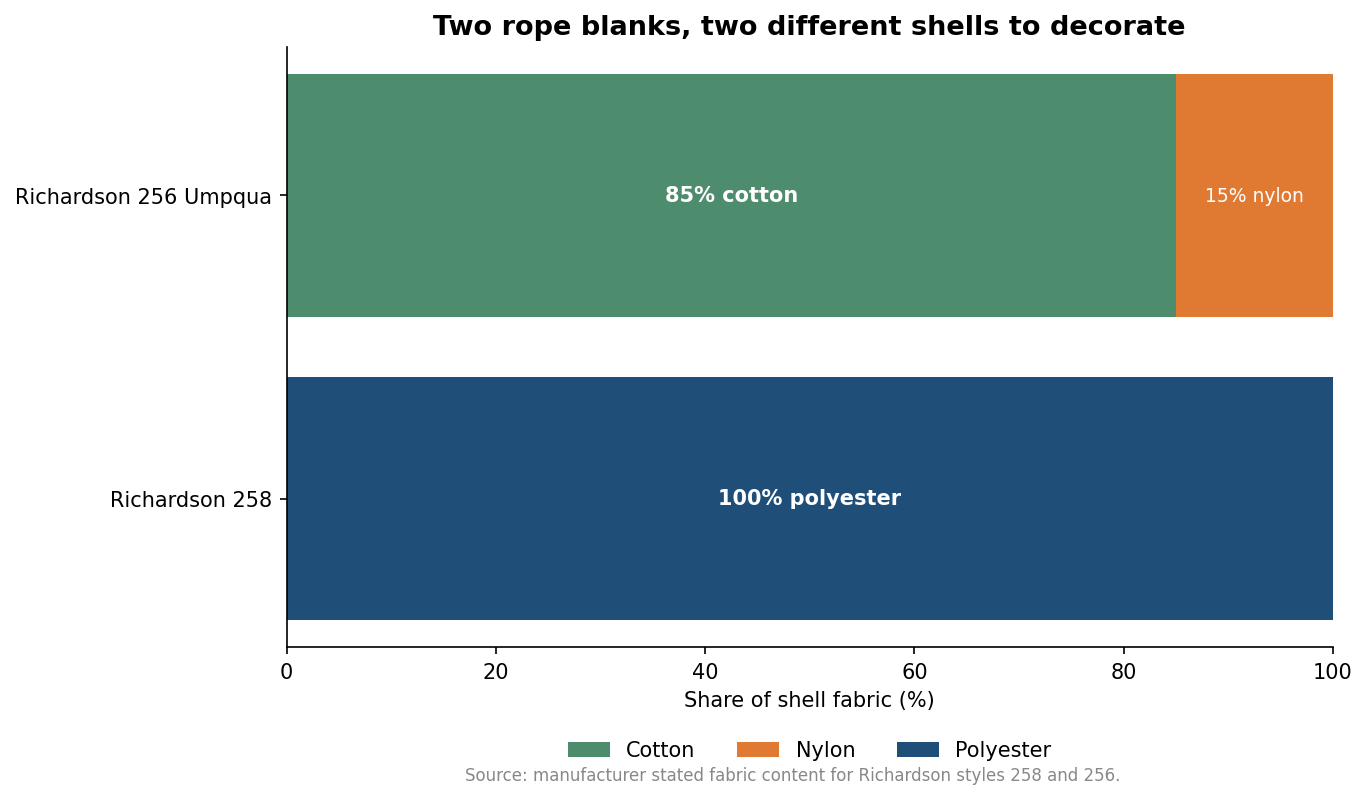
The 258 is the newer and more athletic of the pair. It is a five-panel cap in Richardson’s mid-pro shape, built from 100% performance polyester with a structured front that stands up on its own before a single stitch goes in. The visor is precurved, the closure is a plastic snapback, and a Stay-Dri moisture-wicking sweatband replaces the plain cotton band of an older trucker. That structured crown is exactly why golf, corporate, and event orders gravitate to the 258: it holds 3D puff embroidery and woven patches cleanly, and the polyester shell keeps color consistent from one production run to the next — which matters a great deal when a brand reorders the same hat twice a year and expects the second batch to match the first.
The Richardson 256 Umpqua at a glance
The 256 Umpqua trades the sport look for a heritage one. Its shell is an 85% cotton, 15% nylon blend, the crown is soft-structured rather than rigid, and the visor is flat instead of precurved — the silhouette outdoor and lifestyle brands ask for by name. It carries a UPF 50+ rating and is typically stocked in a wider colorway range, commonly 18 or more, against roughly 14 for the 258. The flat brim is more than a style choice: it lets you place embroidery closer to the bill edge and gives a patch a broad, even surface to sit on. The softer crown drapes a little more, so very small text can distort if it is not digitized for a slightly forgiving base. In practice the 256 rewards bold, simple artwork and punishes cramped, fine detail.
How the blank quietly changes your decoration
The fabric difference shown above is the single biggest driver of how a logo turns out. Polyester, as on the 258, is smooth and dimensionally stable, which suits fine detail and small lettering but can reveal needle holes if a design is over-stitched. The cotton-nylon 256 has a touch more give, which flatters patches and puff embroidery but asks for careful stabilizer choice on tiny text. Visor shape matters just as much: a flat 256 brim can be decorated almost edge to edge, while the precurved 258 needs artwork placed slightly higher so it does not bend around the curve and distort. Structure decides what a patch does at rest — a rigid 258 front keeps a leather or PVC patch flat and legible, whereas the softer 256 lets it flex with the cap for a more relaxed look. None of this makes one blank better than the other; it makes each of them better for a specific decoration method, which is the whole point of choosing deliberately.
Quantities, cost, and lead time
Both blanks follow the same ordering math, and it rewards planning ahead. At Customized Rope Hats the minimum order is 12 caps, and the cost per hat comes down as the run grows. A 3D puff or patch usually costs more than flat embroidery, so ask for a quote with each option. Turnaround for a standard order is about 2 weeks after you approve the mockup, and longer during the fourth-quarter rush or when you are matching a specific Pantone rope color. Because the rope and panel colors are ordered from stocked blanks, availability can shift season to season, so it is worth confirming your exact combination before you lock a launch date. Ordering a size run of a few spare blanks is cheap insurance against a mis-stitch on a tight deadline.
A simple way to decide
If you want a clean decision rule, reach for the 258 when the hat needs to look sporty, shrug off sweat, and reorder identically — golf outings, corporate gifts, and race-day merch all fit. Reach for the 256 Umpqua when the brand wants a flat-brim heritage feel, a cotton hand, or genuine sun protection, and especially when a broad patch is the centerpiece of the design. Whichever way you go, confirm the exact rope and panel colors against a current swatch before you commit, since stocked colorways move around through the year, and order a small sample first any time the logo carries fine detail. The blank is the foundation everything else is stitched onto, and getting it right up front is the cheapest quality decision in the whole order.